
The Latest Microsoft Outage and the Wake Up Call for Small Businesses
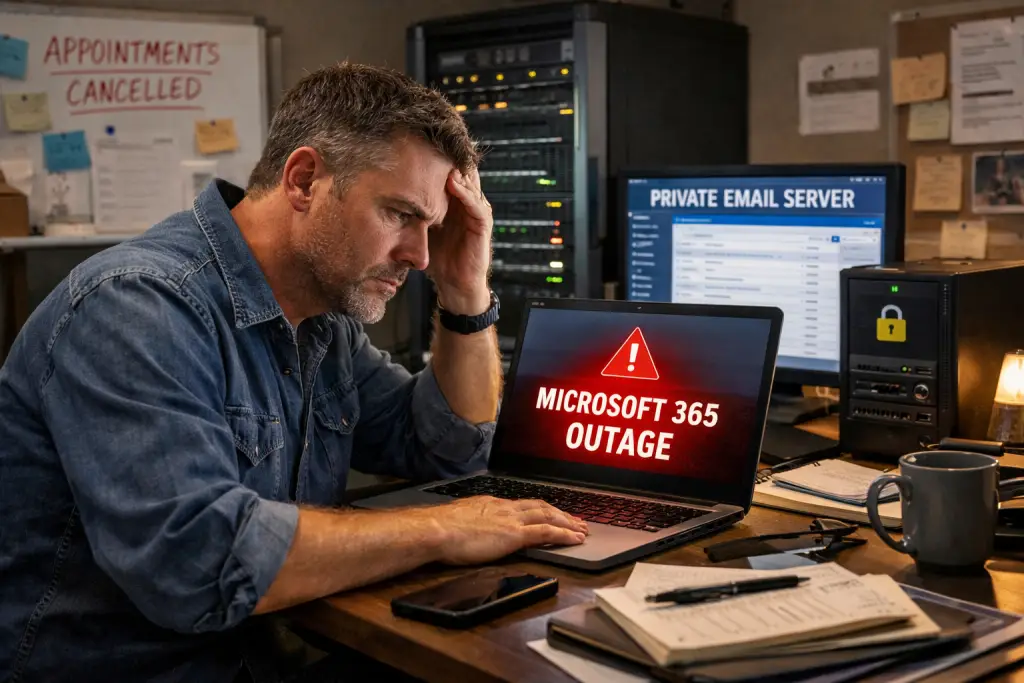
On January 22, 2026, Microsoft 365 had a major outage that hit thousands of users, with reports spiking across North America. Users could not reliably access email and other Microsoft 365 services, and many saw send or receive failures tied to temporary server issues. Microsoft publicly acknowledged the disruption and traced it back to a portion of their service infrastructure that was not processing traffic as expected, then worked through remediation by restoring infrastructure health and rebalancing traffic.
If you are a small business, this kind of outage is not just an inconvenience. It is lost revenue, missed appointments, stalled operations, and a support nightmare.
What small businesses actually experienced
When Microsoft 365 goes sideways, it is rarely just one thing. It is a chain reaction:
-
Email disruption: Outlook and Exchange Online issues meant messages were delayed, bounced, or stuck in limbo.
-
File and workflow disruption: If your business lives in OneDrive and SharePoint, access problems can pause day to day work instantly.
-
Security and compliance disruption: Some reports noted related impact to Microsoft Defender and Purview, which matters a lot if you rely on cloud tools for security monitoring and compliance workflows.
And here is the part many business owners do not realize: even if your company buys Microsoft through a reseller, you can still be down when Microsoft is down. For example, GoDaddy posted a Microsoft Office 365 Email degraded accessibility incident on January 23, 2026, tied to Microsoft 365 connectivity issues, which impacted customers trying to access and use email services.
We have become too dependent on the cloud
I am not anti cloud. I run cloud services every day for clients. The problem is the way small businesses have been pushed into an all or nothing setup.
Over the last decade, we have moved email, calendars, files, chat, identity, and even security into a few massive platforms. That is convenient when everything is healthy. But when a major provider has a bad day, small businesses can feel completely helpless.
Why? Because the cloud is not just a tool anymore. It is the entire building.
When the cloud goes down:
-
Your staff cannot communicate normally
-
Your customers think you are ignoring them
-
Your internal files, quotes, and job info may be inaccessible
-
Your scheduling, invoicing, and logins can get messy fast
This outage was a reminder that even the biggest providers can have regional infrastructure failures that take hours to fully stabilize.
The solution: regain control with a private email platform
If your business wants real independence, the answer is not panicking and switching from Microsoft to Google, then back again. That is just trading one dependency for another.
The real move is owning your own email platform.
That can mean:
-
Hosting your own mail server for your domain
-
Running your own webmail and mobile sync
-
Keeping your data under your control
-
Building redundancy and continuity that you choose, not whatever a vendor decides
What “hosting your own email” looks like in 2026
A properly built business email system is not some junky server in the corner with default settings. Done right, it is a full stack:
-
Mail transport and storage (Postfix, Dovecot, and related components, or a hardened all in one platform)
-
Webmail and admin portal
-
SPF, DKIM, and DMARC done correctly so your mail actually delivers
-
Strong spam filtering and threat protection
-
Enforced TLS, modern ciphers, and secure authentication
-
Backups and offsite retention
-
Monitoring, logging, and alerting
-
Disaster recovery planning and documented procedures
This is where most DIY setups fail. Email is one of the hardest things to self host because deliverability is unforgiving. You need correct DNS, correct server reputation strategy, correct security controls, and ongoing maintenance. One sloppy configuration can land you on blocklists or cause silent delivery failures.
Options that help businesses break away from Big Tech platforms
Depending on the business, budget, and compliance needs, there are a few solid directions:
-
Private VPS email server (most common for my clients)
You run the email platform on a hardened virtual server in a reputable data center, with proper backups and monitoring. This avoids the “server in your office” problems like power outages and ISP issues, while still keeping you independent from Microsoft and Google. -
On prem email server (for specific compliance or control requirements)
Some organizations want everything local. This can work, but you must invest in power protection, redundant internet, security monitoring, and backup strategy. -
Hybrid continuity setup (best of both worlds)
Even if you stay on Microsoft 365, you can add continuity that keeps mail flowing during outages. Think secondary MX, spooling, and emergency inbox access, so you are not dead in the water when a vendor has a bad day.
Why I am comfortable recommending this
I have built and supported email platforms for clients for years. I know where the pitfalls are, and I know what it takes to make self hosted email reliable and secure.
For the right organization, I do full email server deployments starting at $10,000. That price point exists for a reason: this is not just “install a mail server.” It is architecture, security hardening, DNS and deliverability, migration planning, user cutover, documentation, and ongoing support.
If you are reading this and thinking, “I just want email that works no matter what Microsoft does,” then we should talk.
The real takeaway from the Microsoft outage
Microsoft will recover. They always do. The bigger question is what your business learned.
If one outage can freeze your operations, you do not have an email problem. You have a resilience problem.
The businesses that win in 2026 and beyond are the ones that:
-
Treat email and identity like critical infrastructure
-
Build continuity plans before the emergency
-
Own their data, or at least own a realistic escape plan
If you want to explore a private email platform, a hybrid continuity plan, or a full migration away from Microsoft, Google, and Apple ecosystems, reach out to me through my site and I will map out the cleanest path based on your size, risk tolerance, and budget.