
What Are AI Agents and How They Will Change Productivity in 2026
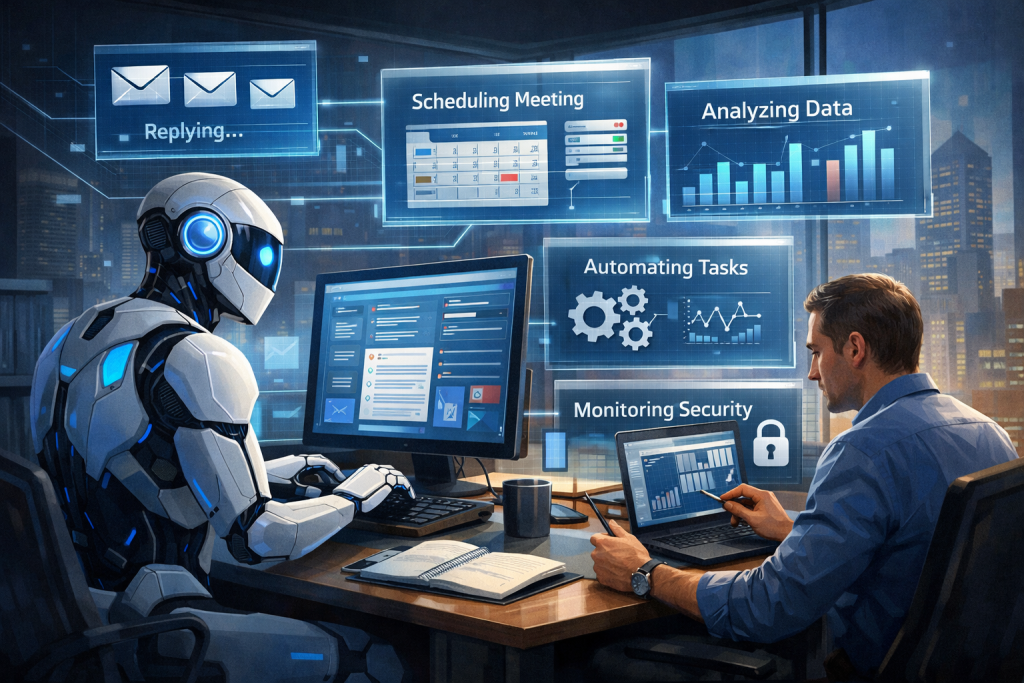
Artificial Intelligence is no longer just answering questions or writing short bits of text. A new evolution is happening right now, and it is called AI Agents.
In 2026, AI agents will fundamentally change how work gets done. They will not just assist you. They will act on your behalf, complete tasks end to end, and operate continuously in the background.
This shift will redefine productivity for individuals, small businesses, and enterprises alike.
Let’s break down what AI agents are, how they work, and why they will become one of the most important productivity tools of the next few years.
What Are AI Agents?
An AI agent is an artificial intelligence system that can:
• Understand goals
• Make decisions
• Take actions
• Learn from outcomes
• Operate across multiple tools and systems
Unlike traditional AI tools that wait for instructions, AI agents can plan, execute, and adjust on their own.
Think of an AI agent as a digital employee that does not sleep, forget, or get distracted.
AI Tool vs AI Agent
Here is the simplest way to understand the difference:
Traditional AI tools
You ask a question or give a command.
They respond once.
You do the rest.
AI agents
You give a goal.
They figure out the steps.
They execute the work.
They report results.
This is a massive leap forward.
What Are GPT-Style AI Agents?
GPT-style AI agents are built on large language models that understand natural language, context, and intent. What makes them different is how they are used.
Instead of just chatting, these agents can:
• Read and write emails
• Schedule meetings
• Analyze data
• Generate reports
• Interact with APIs
• Use business software
• Monitor systems
• Trigger actions automatically
In 2026, GPT-style agents will be embedded directly into operating systems, business platforms, and cloud services.
How AI Agents Will Change Productivity in 2026
1. Work Will Shift From Doing to Directing
Instead of manually completing tasks, people will focus on setting goals and reviewing outcomes.
Example:
Instead of spending two hours replying to emails, you tell an AI agent:
“Handle customer follow-ups and escalate urgent issues.”
The agent does the rest.
This allows humans to focus on strategy, creativity, and decision-making.
2. Small Businesses Will Operate Like Large Companies
AI agents will give small teams the power of much larger organizations.
A single business owner will be able to deploy agents that handle:
• Customer support
• Scheduling
• Invoicing
• Marketing campaigns
• Lead follow-ups
• System monitoring
This dramatically reduces overhead while increasing output.
3. Productivity Will Become Continuous
AI agents do not work in blocks of time. They operate continuously.
That means:
• Issues are detected faster
• Tasks are completed overnight
• Systems are monitored 24/7
• Reports are ready before the day starts
By 2026, productivity will no longer stop at the end of the workday.
4. Fewer Repetitive Tasks, Fewer Burned-Out People
One of the biggest productivity killers today is repetitive, low-value work.
AI agents will absorb tasks like:
• Data entry
• Status updates
• Form processing
• Ticket triage
• Report formatting
This reduces burnout and allows people to focus on meaningful work.
5. Decision-Making Will Become Faster and Smarter
AI agents will not just execute tasks. They will analyze patterns and provide recommendations.
Examples include:
• Identifying inefficiencies
• Flagging unusual activity
• Predicting issues before they occur
• Suggesting optimizations
This leads to better decisions with less guesswork.
Real-World Examples of AI Agents in Action
Business Operations
An AI agent monitors systems, identifies problems, creates tickets, and notifies the right people automatically.
Marketing
An AI agent creates content drafts, schedules posts, tracks performance, and adjusts campaigns based on results.
IT and Security
An AI agent watches logs, detects suspicious behavior, applies predefined responses, and alerts administrators.
Personal Productivity
An AI agent manages calendars, reminders, emails, and task prioritization across platforms.
Are AI Agents Safe?
AI agents must be properly designed and governed.
Key safeguards include:
• Permission limits
• Audit logs
• Human approval checkpoints
• Role-based access
• Clear boundaries
In 2026, the most successful organizations will be the ones that combine AI efficiency with human oversight.
Will AI Agents Replace Jobs?
AI agents will not replace people. They will replace tasks.
Jobs will evolve. Roles will shift toward:
• Oversight
• Strategy
• Creativity
• Client relationships
• Problem-solving
Those who learn how to work with AI agents will become significantly more valuable.
Why AI Agents Matter Right Now
AI agents are not a distant future concept. They are already being deployed today in early forms.
The businesses and individuals who start learning how to use them now will have a massive advantage in 2026 and beyond.
This is the next productivity revolution.
Final Thoughts
AI agents represent a fundamental change in how work gets done.
They move us from manual execution to intelligent automation, from reactive workflows to proactive systems, and from limited output to scalable productivity.
The question is no longer if AI agents will change productivity.
The question is how ready you are to use them.
AI agents are becoming a core part of modern IT and automation strategies for businesses of all sizes.